Over the course of our project, I feel that my knowledge of new media technologies has grown from basic the understanding of editing software and that I now am capable of using appropriate, specific programs such as Photoshop to create professional and high quality media work. It is because of this development that I believe we were able to produce our final project at a high standard.
In regards to the construction of our project, we used a 'Cisco Flip video Ultra HD' to film our trailer. As we had used a more traditional camera in our preliminary and 1st year projects, we had to learn how to use the camera as quickly and thoroughly as possible in order to start filming. Fortunately the flip camera has a simple format in which video files can be directly transferred to a computer through the in-built USB, so uploading clips in order to edit them posed no problem for us.
To edit our film we used the program 'Coral video studio Pro' which we had easy access to as it was installed on the school computers. We used this media technology to 'cut' our film clips and re-order them, input sound files and sound effects (such as the door opening), distort the colours of particular clips and adding titles (fading to black for the introductions) and distorting the speed of clips (slow-motion for the car slide scene). We also used the 'fade to black' effect multiple times to ensure the transition of one clip to another was smooth.
The four music tracks that feature in our trailer were all downloaded from 'www.audionetworkplc.com'. We had prior experience with this website as we had utilised it for both of our previous projects. The sound files were all relatively cheap (59p) which meant that they were within our monetary range and we could search the site for the exact type of music we were hoping for.
For our research, we used YouTube to search for examples of professional film trailers and analyse them. This was particularly useful as we could view any trailer repeatedly to ensure we didn't miss any details that may have helped in the construction of our own trailer.
We also used 'www.facebook.com' and 'www.blogger.com' as outlets for our questionnaire research. These websites were used as they are recent forms of media and are currently very popular, and we therefore decided these sites were the best way to distribute our questionnaire to the most amount of people.
To plan our project we used a series of email conversations (as shown earlier in this blog). We did this on order to ensure that we agreed on project decisions (such as which clips would be used) and to determine the time and location of each film clip.
We also used 'Microsoft Excel' to construct a filming schedule so that we could distribute it to each actor and confirm that each required person could be available on the necessary day and time.
To evaluate our trailer we used a combination of 'www.facebook.com', 'www.blogger.com' and 'www.youtube.com', specifically enabling the ability to leave comments anonymously. This therefore allowed us to analyse these comments and use them as feedback for our evaluation.
Tuesday, 12 April 2011

Monday, 4 April 2011
Evaluation - What have you learned from your audience feedback?
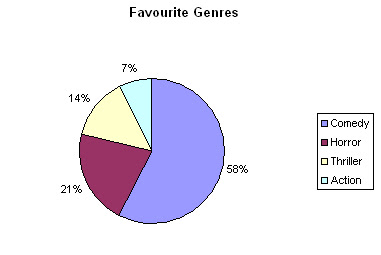
From our questionnaire we learned that the most popular genre was comedy (58%), with the three following most popular genres being related to high tension films (Horror, thriller, and action). We learnt from this that our audience values entertainment highly, and that the combination of action and comedy genres could be the best solution to attract the widest audience. We also learned that the audience regards the narrative as an important aspect in a film, as under 'favourite film and reasons why', 5 votes for the reason why were due to an excellent storyline. We therefore considered focusing upon narrative over humour, but as we were developing a trailer rather than a feature-length film, we decided that the narrative required less attention as we could expose the audience to enigmas and leave them unanswered.
It is important to remember, however, that the results of our questionnaire are likely to be biased. 71% of our participants were male, meaning that our results can generally be applied to males with a good degree of validity, but not to females. We therefore learned that we needed to take greater time considering both genders during the development of our trailer, to ensure our product was not male-orientated and to expand our target audience to everyone.
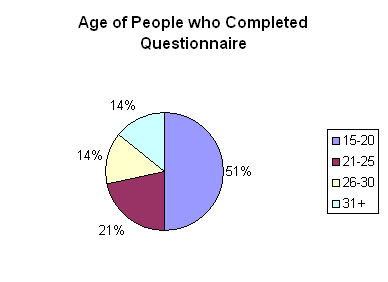
The age range of our participants could also be a cause for bias, as over half (51%) of those who took part were within the 15-20 age range. As this was also mine and Gareth's age range, we learnt that with this added information we were best equipped to target this age range as our audience.
As we displayed our trailer in front of family and in class, we received some feedback personally. One person told us that were slightly confused as the indoor scene started (36 seconds in), as there was no build-up to that scene and the audience is just 'thrown' straight into the scene. We could understand this point as the thief does just enter into the room with no prior explanation as to how he got there. However, we did have such a scene which showed the thief breaking into the house, using the 'swoop shot' technique that we had practiced beforehand. Unfortunately we had to cut this scene from the finished production, as when we reviewed the shot we decided that the camera movement was too unstable (due to having to avoid mise-en-scene such as wall hangings and a bookcase) and did not look professional when compared with the rest of our scenes. We therefore learned that if we were to repeat the process we should try to use a raised track, to keep the camera stable and at the height that we wanted. We would however need to ensure that the enigmas displayed were not solved within the trailer, just clearly defined, to provide the audience with a greater understanding as to why they might want to see the full film.
It is important to remember, however, that the results of our questionnaire are likely to be biased. 71% of our participants were male, meaning that our results can generally be applied to males with a good degree of validity, but not to females. We therefore learned that we needed to take greater time considering both genders during the development of our trailer, to ensure our product was not male-orientated and to expand our target audience to everyone.
The age range of our participants could also be a cause for bias, as over half (51%) of those who took part were within the 15-20 age range. As this was also mine and Gareth's age range, we learnt that with this added information we were best equipped to target this age range as our audience.
As we displayed our trailer in front of family and in class, we received some feedback personally. One person told us that were slightly confused as the indoor scene started (36 seconds in), as there was no build-up to that scene and the audience is just 'thrown' straight into the scene. We could understand this point as the thief does just enter into the room with no prior explanation as to how he got there. However, we did have such a scene which showed the thief breaking into the house, using the 'swoop shot' technique that we had practiced beforehand. Unfortunately we had to cut this scene from the finished production, as when we reviewed the shot we decided that the camera movement was too unstable (due to having to avoid mise-en-scene such as wall hangings and a bookcase) and did not look professional when compared with the rest of our scenes. We therefore learned that if we were to repeat the process we should try to use a raised track, to keep the camera stable and at the height that we wanted. We would however need to ensure that the enigmas displayed were not solved within the trailer, just clearly defined, to provide the audience with a greater understanding as to why they might want to see the full film.
Wednesday, 30 March 2011
Evaluation - In what ways does your media product use, develop or challenge forms and conventions of real media products?
During our earlier research, we analysed films from similar genres (Hot fuzz, the other guys, etc.) in order to challenge or use the same conventions and techniques that we had seen.
The first convention that we could relate to our trailer is the 'eye stare' scene from Hot Fuzz (4-5 seconds in). This is used in combination with eerie music to build tension as dramatically as possible, suggesting an action sequence is about to take place. We used this technique at the start of our own trailer to build tension in a similar sense. However, we challenged this convention by using the audiences expectation of an action scene and replacing it with a funny one, in order to establish our spoof action/comedy genre.
From the film 'Paul Blart: Mall Cop' (8-15 seconds) we noted how an unexpected change in atmosphere in a trailer, or a scene that does not follow in sequence or with the music, can be humorous to the viewer. This was because at the very beginning of the Paul Blart trailer, we see a character who appears unfit despite the surrounding characters suggesting this location takes fitness very seriously. The fact that the tense music and the sound of the man speaking do not alter, despite his appearance on the scene, provides for a subtle joke for the viewer. We therefore used this convention in our own trailer, in our 'car slide' scene. The action build-up beforehand combined with the music suggests that an action sequence is about to take place, but in fact a funny scene occurs instead. We then followed the convention shown by not altering the sound, and keeping the music as action-orientated. This made the funny slide seem out-of-place, adding to the humour of the scene.
Regarding our ancillary tasks we used a number of conventions found in popular magazines and on posters. In both cases we used a large main image, demonstrating the importance of our trailer. We also used stereotypical images and styles associated with out genre/narrative, i.e. sirens in the poster and stripes on the magazine cover. We used the form of a traditional magazine layout, as we had a large-font title at the top, a main feature in the middle and snapshots of other films (to suggest a review later in the magazine) at the bottom. We also included a barcode and a price on the magazine to add a sense of realism, but developed the convention of having them located next to eachother (which is usually seen on most magazines), and instead had them separated.
The first convention that we could relate to our trailer is the 'eye stare' scene from Hot Fuzz (4-5 seconds in). This is used in combination with eerie music to build tension as dramatically as possible, suggesting an action sequence is about to take place. We used this technique at the start of our own trailer to build tension in a similar sense. However, we challenged this convention by using the audiences expectation of an action scene and replacing it with a funny one, in order to establish our spoof action/comedy genre.
From the film 'Paul Blart: Mall Cop' (8-15 seconds) we noted how an unexpected change in atmosphere in a trailer, or a scene that does not follow in sequence or with the music, can be humorous to the viewer. This was because at the very beginning of the Paul Blart trailer, we see a character who appears unfit despite the surrounding characters suggesting this location takes fitness very seriously. The fact that the tense music and the sound of the man speaking do not alter, despite his appearance on the scene, provides for a subtle joke for the viewer. We therefore used this convention in our own trailer, in our 'car slide' scene. The action build-up beforehand combined with the music suggests that an action sequence is about to take place, but in fact a funny scene occurs instead. We then followed the convention shown by not altering the sound, and keeping the music as action-orientated. This made the funny slide seem out-of-place, adding to the humour of the scene.
Regarding our ancillary tasks we used a number of conventions found in popular magazines and on posters. In both cases we used a large main image, demonstrating the importance of our trailer. We also used stereotypical images and styles associated with out genre/narrative, i.e. sirens in the poster and stripes on the magazine cover. We used the form of a traditional magazine layout, as we had a large-font title at the top, a main feature in the middle and snapshots of other films (to suggest a review later in the magazine) at the bottom. We also included a barcode and a price on the magazine to add a sense of realism, but developed the convention of having them located next to eachother (which is usually seen on most magazines), and instead had them separated.
Evaluation - How Effective is the combination of your main product and ancillary texts?
As part of the G324 media brief we had to develop two ancillary tasks, which we chose to be a magazine front cover and a poster. We decided that these two tasks were best suited for us as the other option was a website homepage, and neither of us had any experience within that area. We also had experience with programs such as Photoshop which could be used in the design of posters and magazines.

In order to ascertain a starting point for our poster we looked at film posters of similar genres and narratives, specifically 'Hot Fuzz' and 'The Other Guys'. We noticed how the two main characters stood in the very near foreground, as a typical action-orientated scene took place in the background.
In relation to our trailer, we incorporated 'sirens' behind the title so that the viewer of the poster would instantly recognize that the genre of the film displayed would, at the very least, be part action. This assumption would be enhanced by the background flames, and the unexpected addition of a Mexican-styled costume would demonstrate that the described trailer is actually an action-comedy.

Using our previous research of popular magazines such as 'Total Film' and 'Empire Magazine', we learnt some conventions of magazine front covers and found ways to use and adapt them.
The first thing we noticed during our research was that the magazine title was almost always obscured in some way, usually because of a main character of a new feature film partially blocking it. This is done to suggest to the reader that the magazine is already successful and well known, so the reader should already know or easily work out what the title is. It can also be done to draw attention away from the title and to the main feature itself, suggesting that the magazine holds interesting and valuable content.
We used this convention in the sense that our title is partially obscured, but also challenged it by obscuring it with a tear effect rather than by placing the feature in front of it. We did this in order to make the word 'Torn' autological (a word that describes itself) to have a greater visual effect and to make it more memorable.
In relation to our main product, we kept the same title from the poster to add continuity and to develop a sense of realism, due to the fact that when distributing a film, producers attempt to display the title or slogan of the film as much as possible, to increase awareness of the film.
The stripes located behind the words 'news, reviews and movies!' are also associated with the police, being found on police tape. The colours are usually yellow and black however, but this stood out to much on our magazine cover and drew attention away from the main article. We therefore kept the stripes but changed the colours to grey and darker grey, colours which stand out much less.
I believe we made our magazine cover look professional and realistic, but I would like to have included another image that holds great significance in our trailer, such as the car from the car slide scene. This would have held greater similarity with the magazine covers we researched, and also would have had greater relation to our trailer.
Monday, 28 March 2011
Our Finished Film
Here is a link to our finished product:
Bad Cop Bad Cop
We uploaded our film to YouTube originally, where it received 116 views as of today. We then decided that to expand our audience and gain the opinions of our peers/target audience, we would post the film on Facebook where it gained another 46 views. The comments we were given will be further discussed within the 'audience feedback' section of the evauluation.
Bad Cop Bad Cop
We uploaded our film to YouTube originally, where it received 116 views as of today. We then decided that to expand our audience and gain the opinions of our peers/target audience, we would post the film on Facebook where it gained another 46 views. The comments we were given will be further discussed within the 'audience feedback' section of the evauluation.
Friday, 4 February 2011
Amendments to The Chief Ispector Dialogue
After discussing the chief inspector scene with the actors involved, it was decided that Mr Aherne would decide upon his dialogue spontaneously. This was done so that the scene would seem genuine, and myself and Gaz could respond accordingly to the unexpected dialogue. We recorded the scene, and are very pleased with how life-like the scene appears. These are the corresponding changes:
Chief Inspector Scene:
Actors: Mr. Aherne, Tom, Gaz
Camera starts behind Tom and Gaz, and is low angle (to make the chief seem more powerful). The chief is in the centre of the shot, between Tom and Gaz.
Mr. Aherne: "Let me get this right. I want to make it plain to you two donuts! You've made a total mess-up of this operation, and frankly you are so pathetic that if I never saw you again it would be soon enough!"
The camera now cuts to a point-of-view shot of Mr. Aherne, showing Tom and Gaz scared.
Mr. Aherne: "However! You've got one chance to get this operation done right. And look at the state of you, get yourself a disguise!"
This is where the scene would end and the disguise scene would begin. We will also edit the scene so that the disguise music starts after Mr. Aherne says 'However'. This way the music could start off quietly, building up, and increasing tension. By the time that the disguise scene begins, the music would be at full volume which will suggest that this paricular scene is fast-paced or exciting.
Chief Inspector Scene:
Actors: Mr. Aherne, Tom, Gaz
Camera starts behind Tom and Gaz, and is low angle (to make the chief seem more powerful). The chief is in the centre of the shot, between Tom and Gaz.
Mr. Aherne: "Let me get this right. I want to make it plain to you two donuts! You've made a total mess-up of this operation, and frankly you are so pathetic that if I never saw you again it would be soon enough!"
The camera now cuts to a point-of-view shot of Mr. Aherne, showing Tom and Gaz scared.
Mr. Aherne: "However! You've got one chance to get this operation done right. And look at the state of you, get yourself a disguise!"
This is where the scene would end and the disguise scene would begin. We will also edit the scene so that the disguise music starts after Mr. Aherne says 'However'. This way the music could start off quietly, building up, and increasing tension. By the time that the disguise scene begins, the music would be at full volume which will suggest that this paricular scene is fast-paced or exciting.
'Setting' scenes
Although Gareth was unable to attend school recently due to the adverse weather conditions, I decided to try out some 'setting' scenes, which is very small clips (0.5-2 seconds) of the outside of where a scene will be taking place. Examples of this can be seen in the dinner for shmucks trailer at (0.08) and (0.15). Despite both scenes being indoors, a shot of the building is shown quickly beforehand.
One such scene is outside of the house that is robbed. I decided that we may need to explain the setting, rather than just starting the scene inside the house, which may confuse some viewers. I therefore filmed just outside of the location. However I decided to try various scenes with 'Pans' and 'Tilts', rather than just simple scene of the setting. These techniques also draw the attention of the viewer to what they're moving towards, i.e. the house, suggesting that something is about to take place within the house.
However, these setting scenes have been filmed in heavy snow. As we film the indoor scenes, sunlight may shine brightly through the window, confusing the viewer as to whether this is the same location.
One such scene is outside of the house that is robbed. I decided that we may need to explain the setting, rather than just starting the scene inside the house, which may confuse some viewers. I therefore filmed just outside of the location. However I decided to try various scenes with 'Pans' and 'Tilts', rather than just simple scene of the setting. These techniques also draw the attention of the viewer to what they're moving towards, i.e. the house, suggesting that something is about to take place within the house.
However, these setting scenes have been filmed in heavy snow. As we film the indoor scenes, sunlight may shine brightly through the window, confusing the viewer as to whether this is the same location.
Wednesday, 8 December 2010
Todays Attempted Filming
This morning Gareth and I decided to meet at the costume shop at 9, to rent the costumes, and then head to radnor park to film our newspaper/disguise scene. When we met however the shop was closed, and we had to wait for it to open. We eventually rented our costumes however, which consisted of two police helmets, two police pullovers, and two fake moustaches. But by the time we got to our filming location at radnor park and had set up thetri-pod and camera, it had started to rain, and we had to protect the camera from rain damage and therefore had to go inside and cancel our filming.
To try and ensure that we get our filming completed soon, we have taken the following measures:
- We are meeting on Saturday, Monday and Wednesday to film our scenes.
- We have considered an alternative scene to the newspaper scene which will be indoors and therefore unaffected by the weather. This involves quick cut close-up shots of Myself and Gareth getting into 'disguise' then a shot which pulls out to show the whole disguise.
- When we wear our disguises we will take photographs, and edit them for our ancillary tasks.
To try and ensure that we get our filming completed soon, we have taken the following measures:
- We are meeting on Saturday, Monday and Wednesday to film our scenes.
- We have considered an alternative scene to the newspaper scene which will be indoors and therefore unaffected by the weather. This involves quick cut close-up shots of Myself and Gareth getting into 'disguise' then a shot which pulls out to show the whole disguise.
- When we wear our disguises we will take photographs, and edit them for our ancillary tasks.
Wednesday, 1 December 2010
Issues with filming
As I mentioned in my 'weather' post, conditions for filming are becoming less and less suitable, as we are currently experiencing heavy snow and have forecasts for even more snow this week.
It is now a large possibilty that we may have to adapt our script to fit in with the weather, so we have begun to think about outdoor scenes that may have to be changed.
In the first scene of our storyboard, we tilt the camera down from the sky to meet gareth who is drinking. This would actually look quite good in the snow, as the sun may reflect off of falling snowflakes, supporting the idea that the setting is 'nice'. However, we do not want to distract the viewers attention away from gareth, because we have already drawn their eyes to the snow.
But we do not want to run into problems with continuity, with it snowing heavily in one scene and then sunny the next. Therefore, if we were to film in the snow, we may have to film each scene quickly while the snow lasts. Also, if we discovered a mistake with our filming, it may be too late to change it as the snow would probably have gone. So we may have to just 'leave' the mistake, which is obviously not something we want to do.
It is now a large possibilty that we may have to adapt our script to fit in with the weather, so we have begun to think about outdoor scenes that may have to be changed.
In the first scene of our storyboard, we tilt the camera down from the sky to meet gareth who is drinking. This would actually look quite good in the snow, as the sun may reflect off of falling snowflakes, supporting the idea that the setting is 'nice'. However, we do not want to distract the viewers attention away from gareth, because we have already drawn their eyes to the snow.
But we do not want to run into problems with continuity, with it snowing heavily in one scene and then sunny the next. Therefore, if we were to film in the snow, we may have to film each scene quickly while the snow lasts. Also, if we discovered a mistake with our filming, it may be too late to change it as the snow would probably have gone. So we may have to just 'leave' the mistake, which is obviously not something we want to do.
Wednesday, 24 November 2010
Practice Robber Scene
We have produced some practice shots for the 'Break in' scene. This scene took place in my house and we felt as though we needed to see exactly how the camera angles we have planned would be affected by the location, and whether they would still work effectively.
Sam would be playing the role of the thief, but as he was unavailable we decided to use Gareth instead as the shots were not focused upon acting roles but rather developing the camera angles and movements of the scene. This was unfortunate as it meant that Sam missed out on some possible practice but we could overcome this by spending more time on the scene during the actual filming.
Although this is a very unpolished draft of the scene, we decided to edit it to test some of the effects and transitions that we have planned. This included a to-black-and-white snapshot of a scene, in which writing appears, and the last scene where we use a crossover effect to speed up the shot and also to suggest that some time has passed.
Whilst part of the first scene, the very beggining of the scene will have a 'sweep' shot as the theif breaks into the front door. Due to already having practiced this sweep, and time restraints, we decided not to practice this part of the scene to focus on the part that needed further development.
Here is the Practice Scene which is edited but not completed: LINK
Sam would be playing the role of the thief, but as he was unavailable we decided to use Gareth instead as the shots were not focused upon acting roles but rather developing the camera angles and movements of the scene. This was unfortunate as it meant that Sam missed out on some possible practice but we could overcome this by spending more time on the scene during the actual filming.
Although this is a very unpolished draft of the scene, we decided to edit it to test some of the effects and transitions that we have planned. This included a to-black-and-white snapshot of a scene, in which writing appears, and the last scene where we use a crossover effect to speed up the shot and also to suggest that some time has passed.
Whilst part of the first scene, the very beggining of the scene will have a 'sweep' shot as the theif breaks into the front door. Due to already having practiced this sweep, and time restraints, we decided not to practice this part of the scene to focus on the part that needed further development.
Here is the Practice Scene which is edited but not completed: LINK
Wednesday, 17 November 2010
Script
The only scene with any dialogue contained within it is the Chief inspector scene, and therefore our script comprimises of this scene only.
Starting shot of Mr Aherne looking out the window from the side with a serious look on his face
Mr Aherne: I’m giving you two idiots one last chance to catch the worst delinquent in history, currently on trial for stealing a hand-bag and robbing an officer’s house.
Reaction shot of Tom and Gaz looking shifty
Chief Inspector Scene
Actors: Mr Aherne, Tom, Gaz
Scene 3
Scene 3
Starting shot of Mr Aherne looking out the window from the side with a serious look on his face
Mr Aherne: You two…
Shot changes to shot of Mr Aherne from the front with Gaz and Tom in the shot, as he turns around he starts to say
Mr Aherne: are the biggest pair of incompetent buffoons that I have ever had the displeasure of having on my force. You are a disgrace to the police, this nation and to the whole of the human race…
Gaz: (in a feeble voice) but…
Mr Aherne: Shut up I’m talking. I’m giving you one last chance to prove you’re not a pair of stupid, un-educated oafs who…
Mr Aherne: are the biggest pair of incompetent buffoons that I have ever had the displeasure of having on my force. You are a disgrace to the police, this nation and to the whole of the human race…
Gaz: (in a feeble voice) but…
Mr Aherne: Shut up I’m talking. I’m giving you one last chance to prove you’re not a pair of stupid, un-educated oafs who…
Mr Aherne’s voice fades to quietly murmuring in the background as focus changes to see Gaz lean over to Tom in the fore-ground and says
Gaz: What’s an oaf?
Gaz: What’s an oaf?
Tom: It’s the stuff they put in Weetabix
Gaz: Ohhh
Focus changes back to Mr Aherne as his voice fades back in
Gaz: Ohhh
Focus changes back to Mr Aherne as his voice fades back in
Mr Aherne: OI! I’m talking so your not!
Shot of Gaz and Tom looking “scared”
Shot of Gaz and Tom looking “scared”
Mr Aherne: I’m giving you two idiots one last chance to catch the worst delinquent in history, currently on trial for stealing a hand-bag and robbing an officer’s house.
Reaction shot of Tom and Gaz looking shifty
Mr Aherne: You may want to go… in disguise.
Cut to next scene.
This script is by no means the final script and therefore may be adapted in future.
Changes to 'Chief Inspector' Scene
Whilst developing our storyboard we felt that our chief inspector scene seemed lacklustre when compared with our other scenes. We tried to think of a way to expand this scene and give it more depth and meaning to the viewer, keeping them focused on the rest of the trailer.
We have therefore decided to include a small piece of dialogue between my character and Gareth's character. Mid wa into the scene, we have included a part in our script where the chief calls us 'a pair of oafs' to which Gareth leans over to me and says 'what's an oaf?' and I reply 'Its the stuff they put in weetabix.' By using a pull-focus camera technique we believe we can effectively draw the viewer's attention away from the chief and towards us, as we are about to speak. This will demonstrate to the viewer that something of importance is about to be made, and therefore they will be prepared for the joke.
As myself, Gareth and Mr. Aherne will be in this scene, we will have to find someone else, possibly Sam, to be in control of the camera during the pull-focus effect. From my own experience from our AS work I know that this is a difficult technique to pull off effectively, and we must therefore be prepared to repeat the scene many times in order for the pull-focus to work.
We also worry that the scene may now be too long, as comedy trailers generally usually use short quick cut scenes. However, when we come to edit the trailer, if we find the scene becomes too long and slightly monotonous then we can edit out this idea and use the original plan.
This scene is elaborately explained in our script which I shall upload to my blog shortly.
We have therefore decided to include a small piece of dialogue between my character and Gareth's character. Mid wa into the scene, we have included a part in our script where the chief calls us 'a pair of oafs' to which Gareth leans over to me and says 'what's an oaf?' and I reply 'Its the stuff they put in weetabix.' By using a pull-focus camera technique we believe we can effectively draw the viewer's attention away from the chief and towards us, as we are about to speak. This will demonstrate to the viewer that something of importance is about to be made, and therefore they will be prepared for the joke.
As myself, Gareth and Mr. Aherne will be in this scene, we will have to find someone else, possibly Sam, to be in control of the camera during the pull-focus effect. From my own experience from our AS work I know that this is a difficult technique to pull off effectively, and we must therefore be prepared to repeat the scene many times in order for the pull-focus to work.
We also worry that the scene may now be too long, as comedy trailers generally usually use short quick cut scenes. However, when we come to edit the trailer, if we find the scene becomes too long and slightly monotonous then we can edit out this idea and use the original plan.
This scene is elaborately explained in our script which I shall upload to my blog shortly.
Storyboard
These 3 photographs comprimise all of the scenes we are planning to include in our film. This storyboard will become very helpful when we come to film our trailer, as it shows us exactly what camera angles, camera movements, and plot development we will need to consider when filming. This storyboard demonstrates what our film will look like after editing, but we still need to think about the sound and music that will accompany our film.
Now that we each have a copy of the storyboard, we no longer have the worry of having contradicting ideas when we are filming, i.e. we now view each scene in the same way.


Now that we each have a copy of the storyboard, we no longer have the worry of having contradicting ideas when we are filming, i.e. we now view each scene in the same way.


Monday, 15 November 2010
Weather
Throughout our storyboard and mind-mapping processes, we have always imagined that the outdoor scenes would take place in sunny weather. However, being in mid-November means that winter is now upon us and there are now very few sunny days in which conditions are ideal for our film.
This is becoming a major issue for us. Renting police costumes means we have a few weeks to film before having to re-rent them. There are also few days in which both myself, Sam, and Gareth are available to meet up at the same time. Add to this the fact that the weather has to be nice and we are facing a serious problem, with very few chances available to film in perfect conditions.
We do however have a few scenes that are filmed indoors, and therefore weather conditions are irrelevant. We could therefore save these scenes for when the weather makes our other scenes impossible. Although this may disrupt our filming schedule, we may have no other choice.
If the weather stays consistently bad, we may have to rethink and adapt a few of our scenes. We could change ideas so that they take place indoors, or change them so that it would make little difference what the weather is, or adapt part of the storyline so that rain or wind in particular scenes would actually make sense.
Weather is an inconsistent part of the film-making process that we have learnt that we must be prepared for.
This is becoming a major issue for us. Renting police costumes means we have a few weeks to film before having to re-rent them. There are also few days in which both myself, Sam, and Gareth are available to meet up at the same time. Add to this the fact that the weather has to be nice and we are facing a serious problem, with very few chances available to film in perfect conditions.
We do however have a few scenes that are filmed indoors, and therefore weather conditions are irrelevant. We could therefore save these scenes for when the weather makes our other scenes impossible. Although this may disrupt our filming schedule, we may have no other choice.
If the weather stays consistently bad, we may have to rethink and adapt a few of our scenes. We could change ideas so that they take place indoors, or change them so that it would make little difference what the weather is, or adapt part of the storyline so that rain or wind in particular scenes would actually make sense.
Weather is an inconsistent part of the film-making process that we have learnt that we must be prepared for.
Worries with the 'Car Slide' scene
Whilst creating our storyboard some thoughts arose about various problems we might face with our 'car slide' scene.
First is the fact that we want the failed slide to look as real as possible. The original idea was that we run fast into the side of the car at the wrong angle, and therefore fail the attempt and slowly slide off the front of the car, rather than the side, and fall to the floor. Although Sam, who will be playing the thief in our trailer, has kindly accepted for us to use his car for this scene, we cannot rule out the possibility that if we attempt this scene unprepared his car may become damaged in the process. We obviously do not want this and have thought of a few ways to try and reduce the chances of such an occurance:
- Study various scenes from films that use a car slide
- Slowly build up our speed, and use trial and error
- Practice this scene a lot at a safe speed beforehand
Hopefully these techniques will help keep the car, and more importantly us, from damage.
Secondly, we realised we needed a good reason for the car slide to even be attempted in the film. i.e, why not go around the car? We have therefore decided to make the car slide the only 'quick' option for the thief and the two policeman. We think that the best way to do this would be to make the front of the car as close as possible to the back of another car, making going inbetween slow and near impossible. For this however we would need two cars, and we would have to park them so close eachother that they may actually accidently bump into eachother when we set up the scene. Another method we have considered is having a wall in front of a car. Although this may be easier to organise, it would leave little room for us to fall in front of the car during the failed slide attempt. We therefore face the issue of leaving a small enough gap so it would be impractical to run through, but at the same time having the gap big enough so that we could fall off the front of the car.
We have decided that we will go out and practice this scene as soon as possible, to see whether the location will provide us with an answer, or whether it is possible for us to get the gap as we would like it.
First is the fact that we want the failed slide to look as real as possible. The original idea was that we run fast into the side of the car at the wrong angle, and therefore fail the attempt and slowly slide off the front of the car, rather than the side, and fall to the floor. Although Sam, who will be playing the thief in our trailer, has kindly accepted for us to use his car for this scene, we cannot rule out the possibility that if we attempt this scene unprepared his car may become damaged in the process. We obviously do not want this and have thought of a few ways to try and reduce the chances of such an occurance:
- Study various scenes from films that use a car slide
- Slowly build up our speed, and use trial and error
- Practice this scene a lot at a safe speed beforehand
Hopefully these techniques will help keep the car, and more importantly us, from damage.
Secondly, we realised we needed a good reason for the car slide to even be attempted in the film. i.e, why not go around the car? We have therefore decided to make the car slide the only 'quick' option for the thief and the two policeman. We think that the best way to do this would be to make the front of the car as close as possible to the back of another car, making going inbetween slow and near impossible. For this however we would need two cars, and we would have to park them so close eachother that they may actually accidently bump into eachother when we set up the scene. Another method we have considered is having a wall in front of a car. Although this may be easier to organise, it would leave little room for us to fall in front of the car during the failed slide attempt. We therefore face the issue of leaving a small enough gap so it would be impractical to run through, but at the same time having the gap big enough so that we could fall off the front of the car.
We have decided that we will go out and practice this scene as soon as possible, to see whether the location will provide us with an answer, or whether it is possible for us to get the gap as we would like it.
Monday, 8 November 2010
Video Shooting Schedule
This is our shooting schedule that includes where each scene will take place, the order in which we will perform each scene and the actors that will need to be available for each scene. This is a precaution that will ensure our time is not wasted going unnecessarily back and forth between locations. This schedule is slightly misleading as it may make you believe that all people required for the scene are mentioned under the 'actors' heading, wheras in reality another person would be required to be in control of the camera.


Wednesday, 13 October 2010
Questionnaire results and evaluation
We have had 14 people complete our questionnaire and we have recorded these results and transferred them into graphs. Gareth and I have discussed these results and evaluated them, hopefully using the information we have gained to help us advance and improve our film trailer.
When we created the questionnare, we decided to let the participants answer the questions in their own manner. Although this meant it was more difficult to transfer our data into graphs, we felt that if the participants said exactly what they wanted to say then the data would be more reliable than if we restricted their answers.

When we created the questionnare, we decided to let the participants answer the questions in their own manner. Although this meant it was more difficult to transfer our data into graphs, we felt that if the participants said exactly what they wanted to say then the data would be more reliable than if we restricted their answers.

This Pie Chart shows the percentage of each age group who completed our questionnaire. This was an important question for us because if we were going to identify a specific genre from this questionnaire, we wanted to know exactly which majority of age group we would be targeting.
We may have a biased result due to the fact that over half of our participants were within the 15-20 age group, but as we fall under that age category ourselves, we felt that this was the age group we were in a position to understand best and therefore we wanted the most amount of data from that particular age group.

This graph suggests to us that other results in our questionnaire may be biased towards the male gender. This may have been due to the fact that as we work in a boy's school, there are many more males that we know that we can ask to take part in our questionnaire.
As Gareth and myself are also males, we feel we are suited to producing a trailer that is more target-focused on other males, as we have a greater understanding of what other males may like. Therefore, although our data is biased towards males, it can help us target the right audience whilst also opening our demographic to both genders.
This graph shows our recorded answers for our participants favourite genre. The majority of participants enjoyed comedy films the most, which was fortunate as we have already developed some ideas for a comedy film. As the second most favourite, horror conventions may be something we would like to include in our trailer (similarly to Shaun of the Dead).
The graph shows that after entertainment, the audience values excitement highly, as the three other genres are generally for high tension films. This suggests to us that whilst we may want to focus on comedy conventions in our trailer, we should keep in mind that the audience is still looking for some action scenes to keep them on the edge of their seat.
Favourite Movie and reasons why
-Anchorman x4 - Funny
-Blades of Glory x2 - Good actors/Funny
-Inception x3- Storyline
-Saw x2- Storyline
-Kick-ass x3- Action/comedy mix
We decided not to put the results of this questionnaire into graph form as there could have been a large variety of answers from multiple different genres. However, one trend that this graph shows is that our participants enjoy comedy films that star Will Ferrel. He currently stars in the chart-topping 'The other guys' which also suggests his comedy is recent and not outdated. We will therefore be studying his comedy films to see exactly what it is that makes him so popular and try to incorporate this into our own trailer.
Six of our participants reasons for their favourite films was because they were funny. This reinforces the popularity of the comedy genre and demonstrates what specifically makes the films popular. The stroyline was another important point that our participants stated, but as we are only making a trailer and not the whole film, we shouldn't have to put as much thought into the storyline as we would if we were making the whole film.
Favourite part of a Film
-Humour x6
-Twist x3
-Gore x2
-Action x3
The result of this question once again shows us that comedy is currently a very popular genre. Interestingly, three people told us that they enjoyed a plot twist most about a film. This made us think about possible twist or unexpected occurances in the comedy genre. The fact that there were three answers for gore once again made us think about Shaun of the dead and how horror elements and conventions can be included in what is mainly a comedy film.
Wednesday, 6 October 2010
Camera Loan Inquiries and Actor request
Gareth emailed our media teacher Mr. Aherne on his and my behalf, to ask whether or not there would be problems with loaning the camera during the holidays. We also asked whether he would be able to perform the small part of the chief inspector. We asked him because we wanted the chief inspector to look as though they had authority, and had rose through the ranks, and had gained intelligence through experience. This would have been difficult to pull off if the chief was our age as they would not exude as much natural authourity.
This was the email that Gareth sent on our behalf:


This was the email that Gareth sent on our behalf:

This was his reply:

The reply was great for us as it means that with the camera and another actor organised for the half term, we are now another step closer to being ready to start filming.
Final Scene Choices
Gareth and I have been exchanging emails in order to finalise our choices for which ideas will be a part of our trailer. The final ideas we have decided upon are:


1) Handbag Scene
2) Burgler Scene
3) Chief Scene
4) Disguise scene
5) Car slide scene
Back-up scene: Scooter scene
These are our selected scenes that we will be including in our film and therefore we are now in a suitable position to start our filming schedule and organising issues such as actor timetables, props, clothes, locations, etc.
The E-mails discussing our choices are as follows:


Monday, 4 October 2010
Brainstorm and Flow Chart

This brainstorm was created to aid me and my partner Gareth in understanding exactly what we need to be thinking about throughout our film making process.

Subscribe to:
Posts (Atom)